
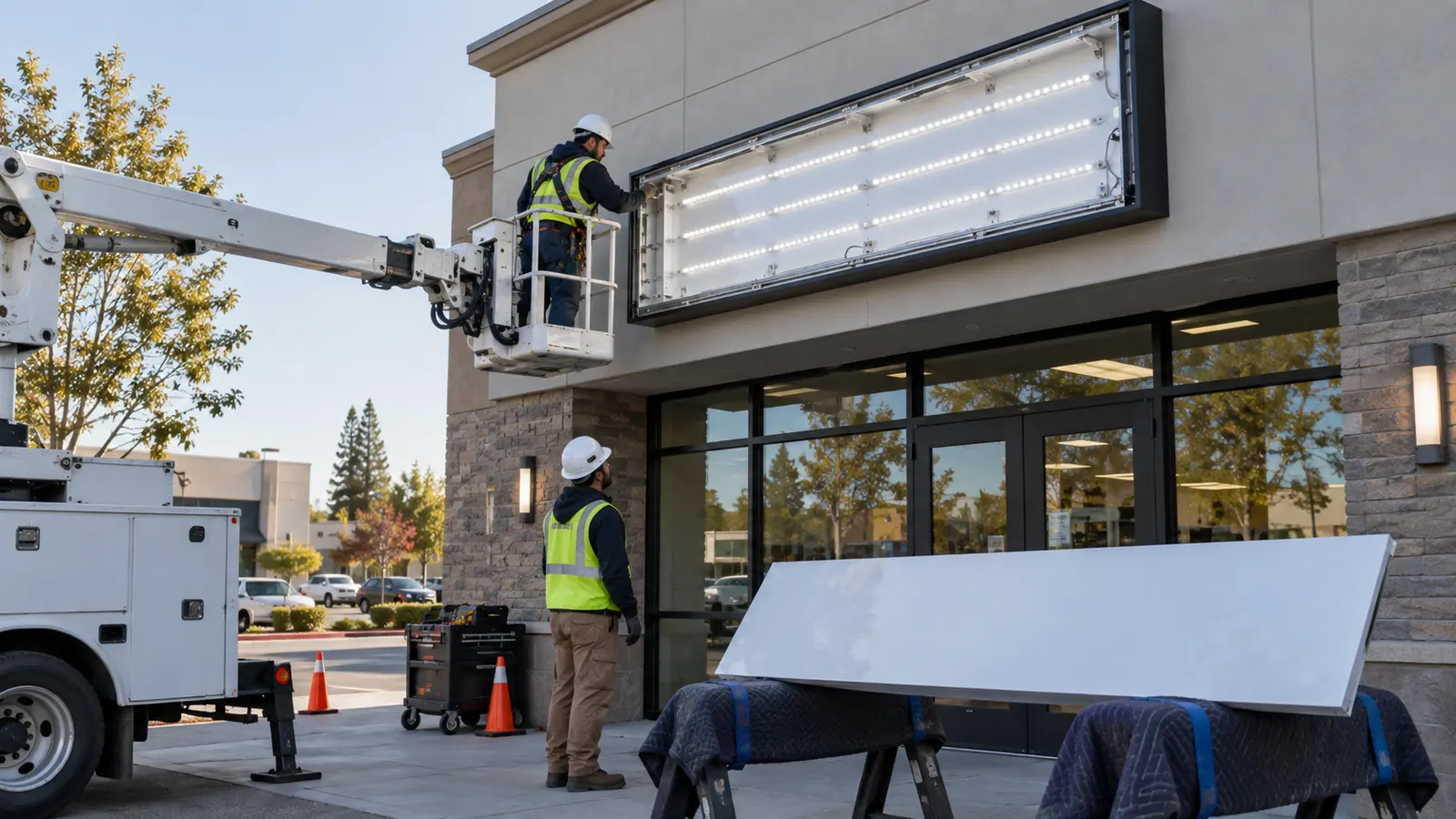
A worn or outdated lightbox face can often be replaced without rebuilding the entire sign cabinet. That does not make every project a simple panel swap. The existing cabinet, retainers, illumination, drainage, wiring, mounting and new artwork all affect whether a reface will produce a clean and serviceable result.
The best first step is a field assessment that separates reusable components from items that require repair or replacement. This prevents a new face from becoming the most visible part of a cabinet that still has uneven lighting, loose trim or water intrusion.
Confirm what type of lightbox you have
Lightbox is a broad commercial term. The sign may be a wall-mounted cabinet, a projecting double-face unit, a monument insert or part of a pylon. It may have one removable face, two opposing faces or multiple tenant panels. Document the complete assembly before ordering material.
- Overall cabinet width, height and depth.
- Visible opening and actual face size.
- Retainer type, dimensions and fastener condition.
- Flat, formed or pan-face construction.
- Single-face or double-face configuration.
- Existing face material and thickness, when verified.
- Illumination type and visible lighting pattern.
- Mounting location, access equipment and service clearance.
Measurements should come from the cabinet, not an old invoice or a photograph. Existing faces may have been trimmed in the field, and opposite sides of the same sign can differ.
Decide whether the cabinet is reusable
A face replacement makes sense when the cabinet remains stable, properly mounted and suitable for the proposed face and lighting system. Inspect the frame, corners, retainers, fasteners, seams, drainage paths and visible corrosion. Note impact damage, distortion and evidence of moisture.
Do not assume the face caused every appearance problem. Dark bands, hot spots and shadows may come from failed or poorly spaced illumination, dirty interiors, aging components or an incorrect face specification. Evaluate the sign both during the day and during an illuminated test.
If the cabinet has structural movement, severe corrosion, damaged retainers or unsafe electrical conditions, a broader repair or replacement scope may be needed. A new face should not be used to hide defects that affect safe service.
Build the replacement face from field dimensions
The production drawing should identify the finished face dimensions, visible copy area, retainer overlap, corner radius, formed depth when applicable and the orientation of every panel. Multi-panel cabinets need planned seams and alignment marks.
Artwork should be scaled and linked to the measured cabinet opening. Include approved logos, colors, typography and any translucent production specifications required by the selected system. The logo file requirements for sign fabrication article explains why editable vector artwork and defined colors create a more reliable starting point than a small raster image.
Review a proof at both full-sign scale and typical viewing distance. A layout that looks balanced on a computer may feel crowded when retainers cover the edge or when the cabinet is viewed from a moving vehicle.
Match materials to the cabinet and exposure
Replacement faces can use different material and graphic systems depending on size, shape, support, illumination, exposure and fabrication method. The fabricator should select a system compatible with the existing cabinet and the approved design rather than copying an unverified material from another sign.
Ask how the proposed face handles thermal movement, wind exposure, attachment and illumination. For a large cabinet, panel joints or additional support may be part of the engineered solution. For a formed face, tooling and depth affect both fit and appearance.
Color evaluation should include transmitted light. A printed or applied color viewed on a white table can shift when illuminated through a translucent substrate. Approve physical samples or controlled proofs when brand matching is important.
Inspect illumination before installing the new face
A new face can reveal lighting defects that were less obvious behind an old or heavily weathered panel. Inspect the existing lighting layout, component condition and access before closing the cabinet. Electrical diagnosis and energized work belong to qualified professionals.
If illumination will be modified, treat that work as a distinct scope with compatible components, service access and required approvals. Avoid unsupported promises about energy savings or service life. The result depends on the original cabinet, selected components, operating conditions and installation.
AA Sign Image’s maintenance and repair service covers sign diagnostics and repair needs that may be discovered during a reface. Coordinate those findings before the replacement face reaches the site so the installation is not delayed by an avoidable second scope.
Check permit and property requirements
Stockton’s sign standards generally require a permit to erect, move, alter or reconstruct a sign. The code also lists certain changes to existing sign copy as exempt when no electrical work is required. The actual treatment of a lightbox reface depends on whether the project changes only copy or also modifies dimensions, structure, illumination or other approved conditions.
Confirm the scope with the local authority and the property owner before fabrication. A shopping center may have its own sign criteria for colors, face construction, illumination and tenant approvals even when the cabinet already exists.
California’s C-45 sign contractor classification covers electrical and non-electrical signs, signs attached to structures and modifications to existing signs. Verify the license and scope appropriate to the actual work.
AA Sign Image’s sign permit and drawing services can help coordinate permit-ready information when the project extends beyond a straightforward copy change. The California sign permit guide provides a broader overview, but the local jurisdiction controls the final requirement.
Plan removal and installation access
A face can be large, flexible and vulnerable to wind. The installation plan should identify lift or crane access, safe staging, customer protection, temporary storage and the method for securing the cabinet while a face is removed. A double-face sign may require different access on each side.
Inspect the retainer and fasteners before the installation date. Missing, corroded or mismatched hardware can turn a planned reface into an incomplete visit. Prepare approved replacement hardware and sealing details without blocking drainage or service access.
Commercial sign installation should follow the approved drawings and actual site conditions. Photograph the open cabinet, completed retainers and illuminated result for closeout.
Compare proposals on the same scope
- Field survey and verified dimensions.
- One face, two faces or multiple tenant panels.
- Flat or formed construction and production method.
- Artwork preparation, proofs and color samples.
- Cabinet, retainer and hardware repairs.
- Lighting inspection or electrical work.
- Access equipment, permits and property approvals.
- Removal, disposal and final illuminated testing.
A low reface price may exclude cabinet repairs, lighting service, access equipment or second-side work. Ask each contractor to state assumptions and exclusions so the proposals can be compared fairly.
Complete day and night quality checks
During the day, review fit, retainer coverage, copy alignment, surface finish and clean edges. At night, look for even illumination, unintended shadows, visible seams and color consistency. Record any cabinet damage that remains outside the approved scope.
Keep the final artwork, face dimensions, material record, photographs and warranty information in the property file. To scope a project, contact AA Sign Image with the address, cabinet photographs, approximate size, night images and editable logo files.
Frequently Asked Questions
Can only one face of a double-face lightbox be replaced?
It may be possible, but both sides should be inspected and compared. Different age, materials, graphics or light transmission can create a noticeable mismatch, and access costs may influence whether replacing both faces is more practical.
Will a new sign face fix uneven illumination?
Not necessarily. Uneven brightness can come from the lighting layout, failed components, cabinet depth, dirt or the face specification. Inspect the illuminated cabinet before deciding that the face alone is the cause.
Does a lightbox sign reface require a permit in Stockton?
A non-electrical copy change may be treated differently from work that changes the cabinet, dimensions, structure or illumination. Confirm the specific scope with the City before fabrication.