
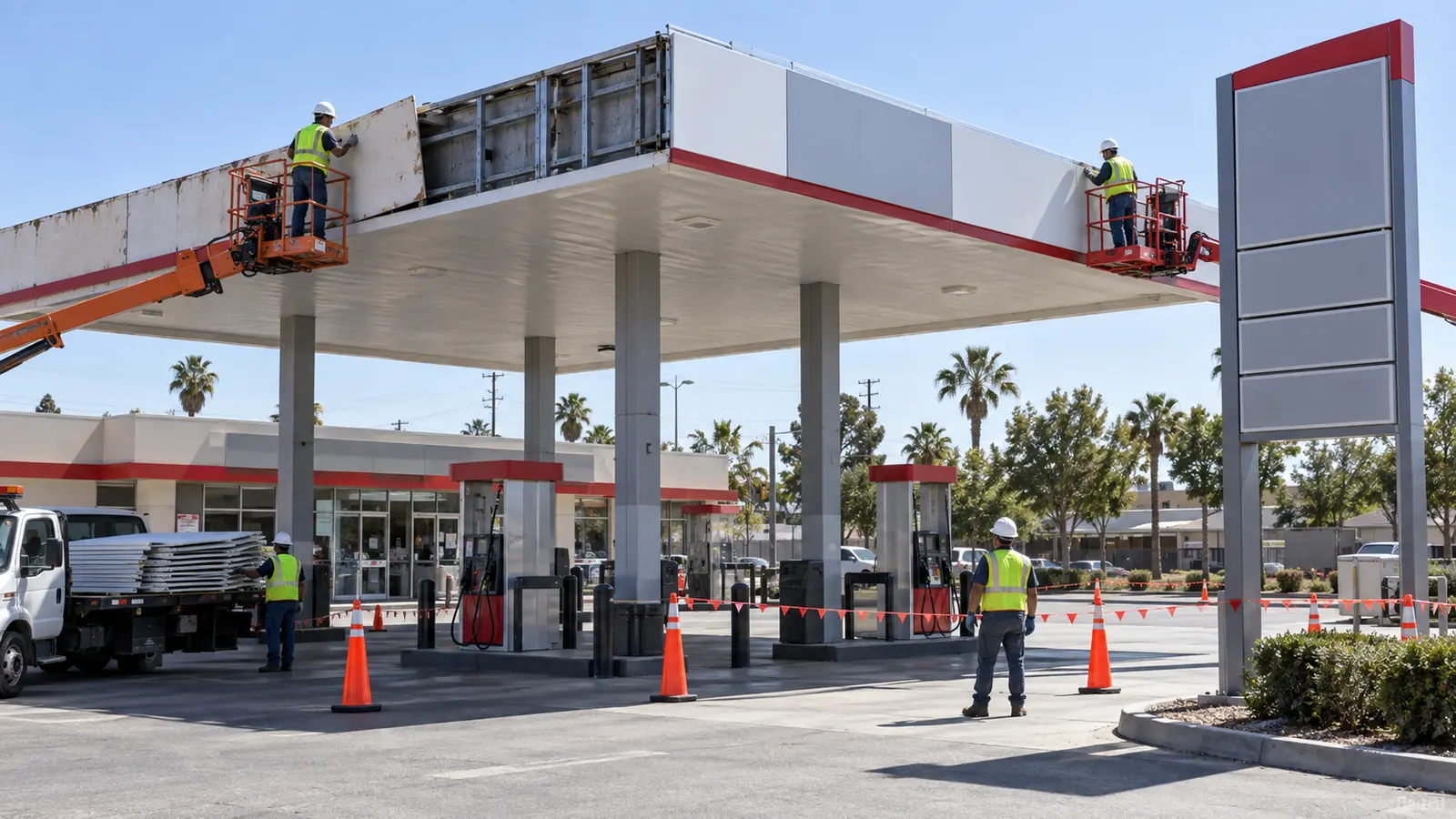
Ending a fuel brand agreement creates a visible deadline across the entire property. Logos and trade dress can appear on the canopy, price sign, building, dispensers, bollards, decals, uniforms and digital listings. Removing only the largest signs leaves an incomplete transition and can create rework when the next brand package begins.
A gas station debranding plan should define what must be removed, what can be neutralized temporarily, what can be reused and what must wait for the incoming program. This checklist gives California operators a practical sequence for coordinating the work while keeping safety, site operations, records and local approvals in view.
Confirm the Contractual Scope and Deadline
Begin with the outgoing brand’s written requirements. Record the termination date, required completion evidence, approved disposal or return procedures, color-removal standards and any restrictions on continued use of branded materials. The brand owner or distributor should resolve questions about trademarks and trade dress.
Separate contractual obligations from permit and construction decisions. A brand deadline does not authorize unpermitted work, unsafe access or disposal outside the agreed process. Assign one person to control the asset list, approvals, photos and closeout package.
Build a Complete Branded Asset Inventory
Walk the site in daylight and after dark. Photograph every elevation and identify each asset with a unique code. Include obvious signs and small repeated elements that are easy to miss.
- Canopy fascia, illuminated bands, logos and corner treatments
- Street pylon or monument sign, fuel price displays and reader panels
- Building signs, wall graphics, window graphics and door decals
- Dispenser graphics, toppers, skirts, nozzles and payment-area decals
- Bollard covers, valances, trash enclosures and directional signs
- Interior point-of-sale graphics and branded operational notices
- Temporary signs, flags and portable promotional materials
- Online profiles, photos and property listings managed by the operator
For each item, record the material, mounting, electrical connection, access method and planned disposition: remove, return, destroy, neutralize, reuse or replace. This inventory becomes the debranding sign schedule and the evidence checklist.
Survey What Lies Behind the Brand Elements
Removing panels can expose faded coatings, old fastener holes, corrosion, seal failures, wiring, mismatched substrates or earlier layers of graphics. A site survey should identify those conditions before the crew and equipment are scheduled.
Note which underlying assets belong to the property and which belong to the distributor or brand. Confirm whether canopy fascia and pylon cabinets are structurally reused, temporarily covered or replaced. If the incoming brand has already been selected, compare its dimensions and electrical needs with the existing conditions before ordering transition materials.
Define the Temporary Identity Plan
A debranded site still needs to be understandable to customers. Plan how the station will identify itself, display fuel prices and communicate entrances, exits and operating information during the transition. Temporary graphics should be neutral, legible and approved by the responsible parties.
Stockton’s sign standards allow temporary business identification signs for a limited period and state conditions on size and duration. Other California jurisdictions use their own rules. Confirm the local allowance, property approval and installation method before relying on a temporary sign.
Do not let temporary work mimic an official traffic device or obstruct sightlines. Keep emergency, safety, accessibility and legally required information in place unless it is being replaced with an approved equivalent.
Separate Sign Work From Fuel-System Work
Debranding often occurs around an operating fueling environment. Define strict scope boundaries. Sign crews should not alter fuel-system components, dispenser certification elements or other equipment outside their authorization. Coordinate with the operator, fuel-system vendors and authorities responsible for the affected work.
If the price sign remains active, preserve accurate and legible pricing through the transition. For projects that change the cabinet, digits or electrical system, use the gas station branding guide for California to identify the information and approvals that may be needed.
Review Permits and Licensed Scope
Local permit requirements depend on what changes. Stockton generally requires a sign permit to erect, move, alter or reconstruct a sign unless a stated exemption applies, while non-electrical copy changes can be exempt under specific conditions. Structural, cabinet, dimensional, location or electrical work can change that analysis.
California’s C-45 sign contractor classification covers electrical and non-electrical signs, including post- or pole-supported signs, signs attached to structures and modifications to existing signs. Confirm that each contractor is properly licensed and working within scope. Obtain owner, landlord, distributor and local approvals as applicable.
Sequence the Field Work
- Approve the asset schedule, removal methods and temporary identity plan.
- Confirm permits, property access, shutdowns and site contacts.
- Stage replacement or neutral panels before removing critical identification.
- Protect customers and employees with controlled work zones and clear routing.
- Remove high-level canopy and pylon elements using the planned access equipment.
- Make substrates weather-tight and address exposed penetrations.
- Install temporary identification and verify operational messages.
- Clean the site and photograph every asset disposition.
Sequence work to minimize the period when the property lacks clear identity. If the station remains open, coordinate lane closures and elevated work around business operations. Stop and reassess when concealed damage changes the scope.
Prepare the Site for the Next Brand
Debranding and rebranding are related but distinct projects. Debranding closes the outgoing program and stabilizes the property. Rebranding introduces new standards, signs, finishes and approvals. Keeping separate schedules and evidence packages makes responsibilities clearer.
Before the new program moves into fabrication, reconcile the verified site survey with the incoming brand manual. The gas station rebranding checklist for California operators covers permits, sign packages and rollout planning, while AA Sign Image’s gas station branding services can coordinate survey, design, manufacturing and installation.
Close Out With Evidence
Create before-and-after photos for every asset ID, plus disposal receipts, returned-material records, permit documents, inspection results and any open punch-list items. Record temporary materials that must be removed later and assign a due date and owner outside the article workflow.
A complete closeout package protects the operator from uncertainty about what was removed and gives the incoming team a clean starting point. To plan a California gas station debranding project, contact AA Sign Image with the site address, outgoing requirements, target transition window and any incoming brand standards.
Frequently Asked Questions
What is included in gas station debranding?
The scope can include canopy fascia and logos, street signs, building signs, dispenser graphics, decals, branded site accessories, interior graphics and closeout evidence. The contract and verified site inventory should define the final list.
Can a gas station stay open during debranding?
Sometimes, with carefully phased work, controlled access and coordination with the operator. Elevated work, electrical shutdowns, lane closures or other conditions may require temporary restrictions. The site-specific safety and operations plan governs.
Does debranding require a sign permit in California?
Requirements vary by city and by scope. A simple non-electrical copy removal may be treated differently from cabinet, structural, dimensional, location or electrical changes. Confirm the work with the local authority before scheduling field removal.