Fuel dispensers occupy the closest point of contact between a gas station brand and its customers. Faded decals, mismatched panels and layers of old adhesive can make a recently updated canopy or price sign feel unfinished. Replacing the graphics can restore a coordinated appearance, but the work should be planned as a measured field project rather than a simple print order.
A successful dispenser graphics replacement starts with an asset inventory, verified dimensions, approved artwork and a clear boundary between cosmetic work and fuel-equipment service. The installation plan also needs to protect operating instructions, required labels, card readers, displays, emergency information and access panels.
Define the graphics scope before artwork begins
Start by listing every dispenser and each surface that may receive a graphic. Two units that look similar from the drive aisle may have different generations, door profiles, screen layouts or previous repairs. Record the manufacturer and model when visible, but rely on field measurements and photographs for the graphics template.
- Number each dispenser and photograph all four sides.
- Record the usable flat areas around screens, keypads, nozzles and access doors.
- Identify existing decals, safety labels, fuel-grade labels and inspection marks.
- Note damaged panels, loose trim, corrosion, deep scratches and old adhesive.
- Separate brand graphics from equipment labels and operational information.
- Confirm whether the scope includes only vinyl, replacement panels or related sign elements.
This inventory becomes the sign schedule for the forecourt. It helps the operator, designer, printer and installer discuss the same surfaces and prevents artwork prepared for one dispenser from being forced onto another.
Protect regulated and operational information
The California Department of Food and Agriculture explains that its Petroleum Products Program regulates advertising and labeling for petroleum products. Its business guide also identifies required information for motor-fuel price advertising signs. A dispenser graphics project should not treat regulated labels, prices or operating information as decorative elements.
Before removal, document every label and notice on the unit. Confirm with the operator which items are supplied by the fuel brand, equipment manufacturer, payment provider, weights and measures authority or another agency. Do not cover, relocate or reproduce required information without an approved instruction.
Graphics installers should also maintain access to screens, card readers, receipt printers, emergency shutoff information, inspection seals and service doors. When the project exposes equipment damage or a fuel-system issue, stop and route that work to the responsible qualified vendor.
Build artwork from verified templates
A production file should show the exact panel outline, cutouts, trim boundaries, overlaps and orientation for each dispenser family. Use vector artwork where possible and include approved color references, logo clear space and a marked scale. A screenshot or social-media logo is not a reliable production master.
The logo file requirements for sign fabrication guide explains why editable vector artwork, approved colors and alternate layouts reduce interpretation before production. For dispenser graphics, the file package should also identify the unit number or template family so that printed sets remain traceable in the field.
Review a scaled proof that includes the dispenser outline, not the graphic alone. This reveals whether a stripe runs into a keypad, whether a logo is hidden by a hose and whether adjacent panels align when doors are closed.
Evaluate the existing surface
Vinyl can only perform as well as the substrate beneath it. During the survey, inspect painted metal, plastic trim and replacement panels for oxidation, chalking, fuel residue, dents, peeling coatings and adhesive buildup. Surface preparation should follow the selected film manufacturer’s technical guidance and the actual panel condition.
A graphic should not be used to conceal a panel that is loose, sharply damaged or unable to provide a stable bonding surface. Document those conditions separately so the operator can decide whether to repair, refinish or replace the panel before graphics installation.
Weather matters too. Installation temperature, direct sun, wind, dust and overnight moisture can affect the working conditions and the ability to keep a forecourt clean. The schedule should include an acceptable weather window and a protected staging area for prepared panels and printed sets.
Coordinate the dispenser graphics with the full rebrand
A dispenser is one part of a larger identity system. Compare its color blocks, logos and messages with the canopy fascia, pylon, price sign, directional signs and storefront. A gas station rebranding checklist helps teams assign each asset and confirm that old brand elements are removed rather than left as small visual conflicts.
AA Sign Image’s gas station branding services include dispenser graphics alongside canopy imaging, price signs and other exterior assets. Combining the field inventory can reduce repeated surveys and make it easier to sequence graphics after dirty repair or painting work is complete.
For an active conversion, establish the exact moment when the new brand may appear. Some programs require old graphics to remain until a coordinated changeover, while others use temporary neutral panels. The operator or brand program should approve that sequence in writing.
Plan installation around safe customer flow
The operator and contractor should decide whether work will occur one dispenser at a time, by island or during a temporary closure. The answer depends on site traffic, access, the graphics method and any parallel equipment work. Cones alone do not replace a site-specific traffic and work-zone plan.
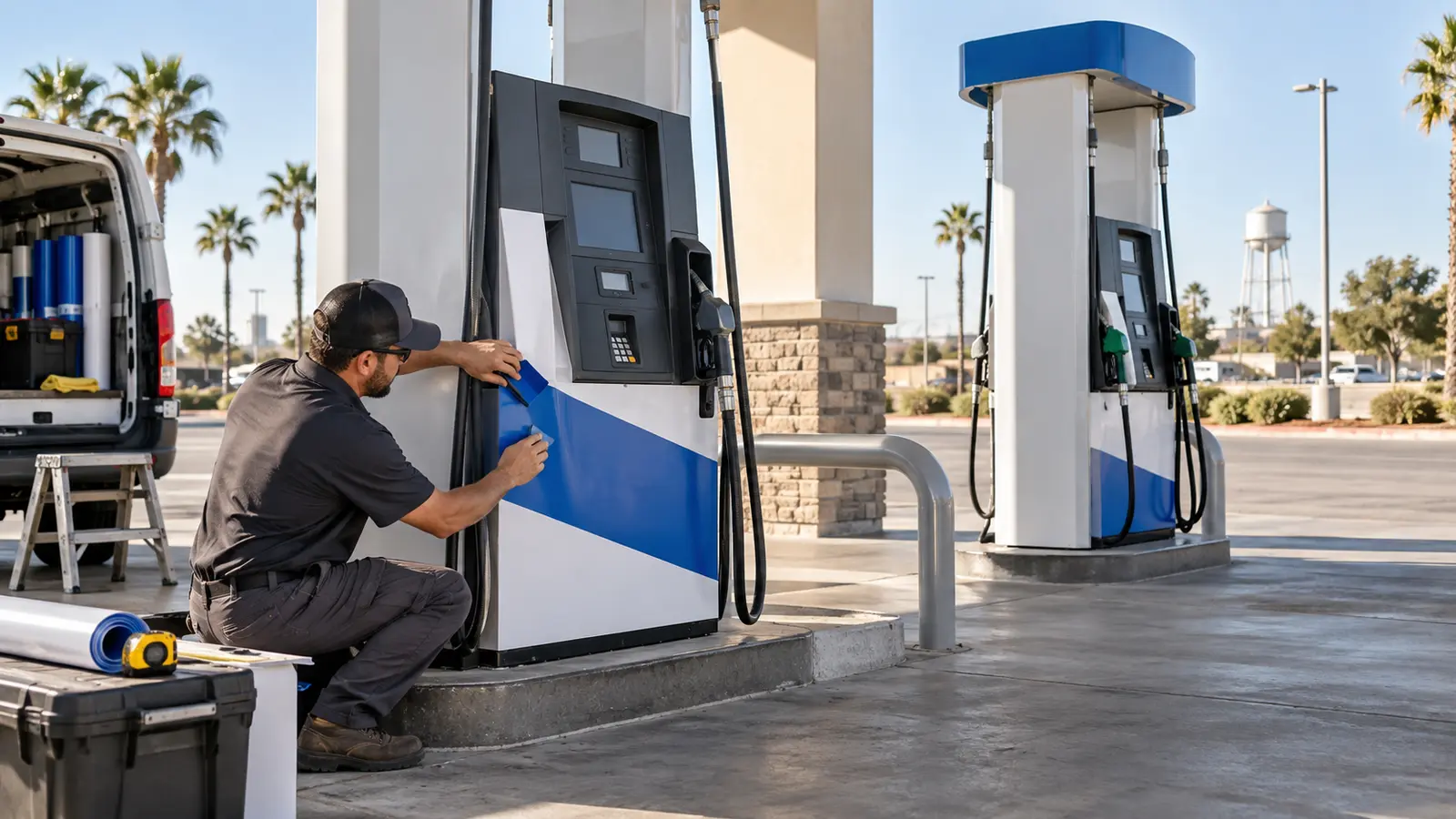
Keep printed sets labeled and organized by dispenser. Remove only the graphics scheduled for that work period, and photograph the condition beneath them. Clean and prepare the surface using compatible products, then install in an order that preserves panel alignment and access to doors and fasteners.
The commercial sign site survey checklist provides a broader way to document access, staging, electrical context and installation constraints before crews arrive. For a fuel site, the operator should also communicate site-specific safety procedures and vendor boundaries.
Review permits and scope boundaries
Stockton’s sign standards generally require permits to erect, move, alter or reconstruct signs, while certain non-electrical copy changes are listed as exempt. Whether a dispenser graphic is treated as sign copy, equipment identification or part of a larger permitted scope depends on the actual work and local interpretation.
Confirm the project with the authority having jurisdiction when the graphics are integrated with cabinets, illuminated elements or structural changes. Do not assume that a copy-change exemption covers electrical work, new sign area or a modified sign structure.
California’s C-45 sign contractor classification includes electrical and non-electrical signs, signs attached to structures and modifications to existing signs. Use appropriately qualified contractors for the components included in the real scope, and keep cosmetic vinyl work separate from fuel-equipment service.
Complete a documented final inspection
- Confirm that each dispenser received the correct approved graphic set.
- Check alignment across doors, seams and adjacent panels.
- Inspect edges, corners, cutouts and overlaps for lifting or stress.
- Verify that required labels, displays, controls and service access remain visible.
- Remove old adhesive, backing paper and temporary markings from the work area.
- Photograph every completed side and record unresolved damage.
- Compare the forecourt with the canopy, pylon and other rebranded assets.
Keep approved artwork, template versions, installation photographs and a dispenser-by-dispenser completion list in the project file. To plan a California fuel-site update, contact AA Sign Image with the address, dispenser count, photographs, known models, brand standards and target changeover date.
Frequently Asked Questions
Can dispenser graphics be replaced while a gas station remains open?
Some projects can be phased one dispenser or island at a time, but the operator and contractor must approve a site-specific sequence and controlled customer path. Equipment work, heavy traffic or overlapping construction may require temporary restrictions.
Should new vinyl be installed over existing dispenser graphics?
The correct method depends on the existing film, adhesive, panel condition and selected product system. Layering can trap defects or create visible edges, so the installer should evaluate the surface and follow the film manufacturer’s preparation requirements.
Do dispenser graphic changes require a sign permit in Stockton?
Requirements depend on whether the work is a non-electrical copy change or part of a larger alteration involving cabinets, illumination or sign structures. Confirm the actual scope with the City before production.